Your cart

Your cart is empty. Start with what fits your wall.

Search

FavouritesSaved looks

Hanging · 6 min read

Art for nurseries and kids' rooms

Nothing heavy or under glass over a crib or a bed, every frame on two fixings, hung at their height rather than yours, and art they won't outgrow by kindergarten. Six rules from a mom of two young kids.

Diana, founderUpdated October 2026

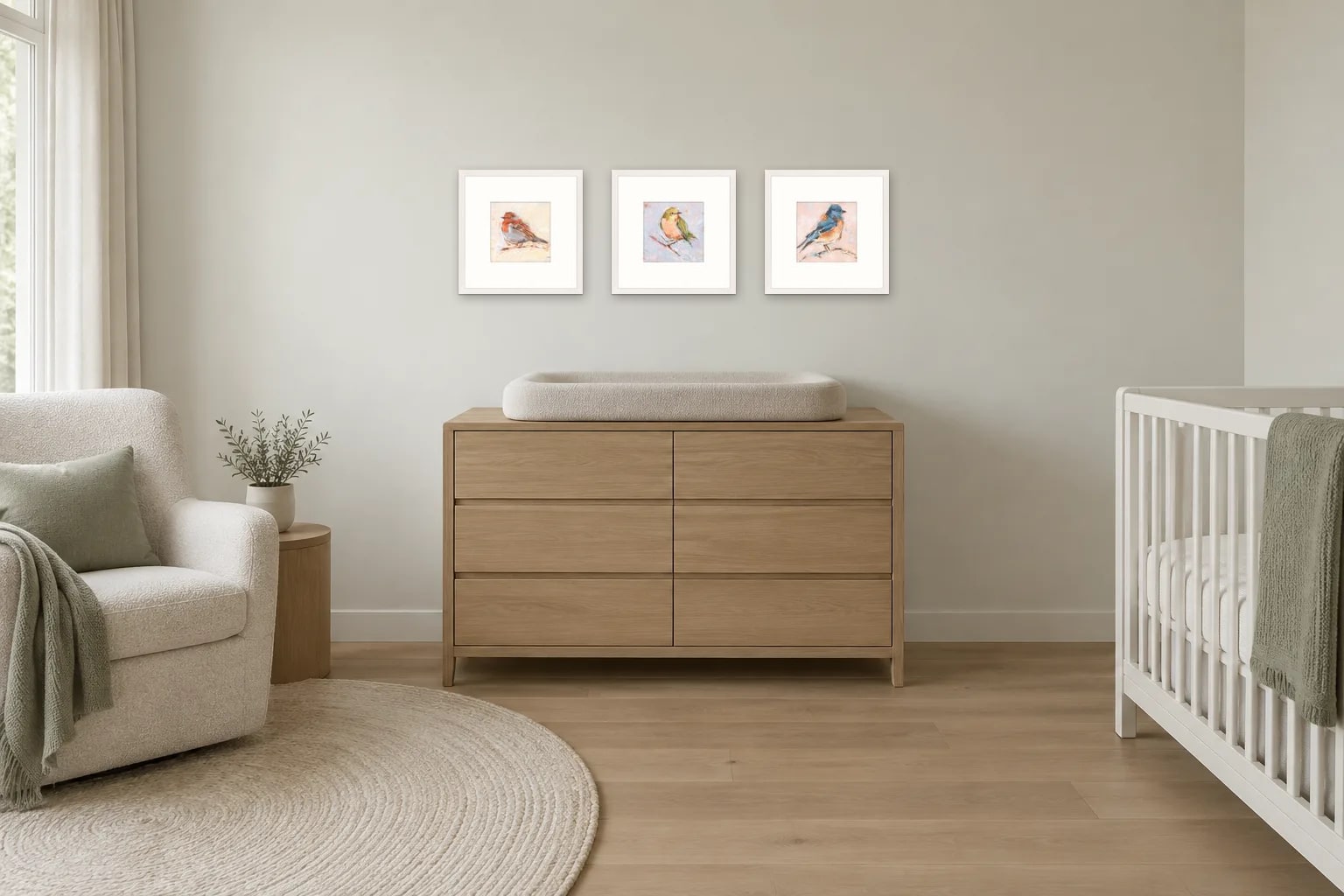
Bird Variety I, II and III by the Burlington studio, each 13 × 13 inches, rendered at approximate scale on a warm white nursery wall above an oak dresser, with a crib and a nursing chair at the sides.Rendered room, approximate scale
Bird Variety I, II and III, each 13″ × 13″, over the dresser and away from the crib

I have two young kids, and I've decorated two nurseries in four years. The first time, I did what most of us do: I found a print I loved, framed it under glass, and hung it right above the crib, because that's where every photo online puts it. It came down that week.

Kids' rooms have different rules from the rest of the house. Little hands reach further than you expect, things get thrown, and furniture gets climbed. None of that means bare walls. It means choosing the piece, the place and the hardware with the child in mind first and the photo second. Here are the six rules I use now.

This guide is general advice about art. For cribs and children's furniture, Health Canada's current safety advice is the reference, so read it alongside this.

1. Is it safe to hang art above a crib?

Not if it's heavy or under glass. Nothing hangs directly above a crib, a toddler bed or a bunk that could hurt a child if it fell: no glass, no heavy frames, no mirrors, no shelves with things on them. Babies learn to pull themselves up on the crib rail sooner than most parents expect, and a standing toddler reaches well above it.

This is the one rule I'd never bend. If you want something above the crib, keep it light, soft and unglazed: a small canvas with no glass, a fabric piece, or a paper print in a lightweight frame with acrylic instead of glass. Better still, move the art to the wall beside the crib and leave the wall above it empty. The room still looks finished.

Nothing hangs over a crib or within reach of it: keep the wall around it clear and hang art beyond that.

2. How far from the crib should art hang?

Out of reach. Keep a clear zone of 36″ (91 cm) on each side of the crib, and the whole wall above it, up to 72″ (183 cm) from the floor. Hang every piece beyond that. My test: if you can touch the piece while leaning over the rail, so can your child, eventually. Keep every wire, string and ribbon out of reach too.

Crib safety advice, Health Canada's included, says to keep a crib away from windows, blind cords and anything a child can reach and pull in. The same applies to art: no pieces a child can grab through the rails, and no picture ledge loaded with frames beside the crib.

3. How should you hang art in a kids' room?

On two fixings, every time: screws into studs, or drywall anchors rated well above the piece's weight. In the rest of the house one hook in drywall is often fine. Here, two fixings keep a frame level when it's bumped, and one failing doesn't bring the piece down.

  • For anything over about 5 lb (2.3 kg), use screws into studs, or drywall anchors whose rating, printed on the package, is comfortably above the weight of the piece.
  • Use D-rings on each side of the frame rather than a wire across the back. A wire lets the piece swing and tilt; two D-rings on two screws hold it flat.
  • For the extra-cautious, security hangers, sold at hardware stores, lock the frame to the wall so it can't be lifted off the hooks.
  • Adhesive strips are fine for light, unglazed pieces on the far side of the room, never above a sleeping place. Art for renters covers what strips really hold.

4. Do you need to anchor the furniture too?

Yes. Art rarely hurts children; furniture that tips over does. Health Canada advises securing dressers, bookcases and other tall furniture to the wall, and anti-tip kits are sold for exactly that. Once a child starts climbing, a dresser with a heavy piece leaning on top is a risk twice over.

So if a piece leans on a dresser in a kids' room, the dresser is anchored and the piece is small and light, or it's hung instead.

5. How high should art hang in a nursery or kids' room?

Lower than in the rest of the house. In a nursery you see the walls from the rocking chair or the floor, so sit in the chair and centre the art closer to where your eyes land: about 50″ (127 cm) from the floor, below the usual 57″ (145 cm). In a kids' room, centre the piece at about 42″ (107 cm), around a small child's eye level; measure with them standing against the wall, and adjust as they grow.

The 57″ rule and the arithmetic for the nail are in How high should you hang art?; only the centre height changes here. Lower pieces need sturdier hanging and no glass, since they'll be touched. That's the trade.

Lower than the usual eye level: where a parent holding a baby, or a small child, can see it.

6. What nursery art won't they outgrow?

Calm colour, simple shapes, and animals drawn for grown-ups. A room themed hard for a baby (alphabet prints, cartoon animals, the name in big letters) usually gets redone within three years. Soft abstracts, landscapes and botanicals still work in a ten-year-old's room, or the guest room after that, so they're cheaper in the end.

The nursery stage is short. What lasts:

  • Calm colour and simple shapes. Start with Quiet neutrals or Botanicals.
  • Animals drawn for grown-ups. A good drawing of a rabbit or a bird outlasts a cartoon one.
  • One piece they choose, one you choose. From about age 3, let them pick one piece for their wall. They notice, and they're more careful with it.
  • Frames that move house. Natural oak or white frames suit almost any room the piece ends up in.

Next step

Measure the wall beside the crib, not above it, and try a piece there at approximate scale in Your Blank Wall. To start with pieces that have no glass to worry about, browse our gallery wrap canvases.

Questions we get asked

Yes, in a kids' room. Acrylic is lighter and doesn't shatter into sharp pieces. If a framed piece you like comes under glass, ask us before you order what the options are, or choose a canvas instead.

A canvas with no glass is my default for kids' rooms. It's light for its size, there's nothing to break, and a bump just bounces off. Check the weight in Product details all the same; large canvases in floating frames can be heavier than they look.

That's outside what we sell, so I'll only say: follow the maker's instructions and Health Canada's current advice, and take down anything hanging over the crib as soon as your child can reach it.

More guides

Keep reading

  • Rooms · 5 min read

    Art for a home office

    The wall you face all day and the wall behind you on every video call are different jobs. How to size art above a desk, what reads well on camera, and why I'd skip glass behind you.

  • Hanging · 6 min read

    Art for renters, without losing your deposit

    Adhesive strips and what they really hold, picture ledges, leaning, and the one small nail hole most leases can live with. Five rules for hanging art in a rental without a fight at move-out.

  • Sizing · 5 min read

    Art for small spaces and condos

    In a small room, one bigger piece usually beats several small ones. How to size art for a condo living room, a narrow wall, the space beside a window, and walls you can't put a hole in.

  • Rooms · 5 min read

    Can you hang art in a bathroom or kitchen?

    Yes, with care about where. Steam, splashes and heat are what damage art, so the answer depends less on the room than on the spot on the wall. The honest version, finish by finish.

  • Rooms · 5 min read

    Cottage and cabin wall art

    Water, woods and old photographs, in frames that stand up to a place you close for the winter. What suits a cottage, what to hang where, and what to bring home in the fall.

  • Rooms · 5 min read

    Dining room art: what size, and how high?

    Above a sideboard, art spans two-thirds of it and sits 8″ above the top. On the wall behind the table, size to the table. And remember most people see dining room art sitting down.

  • Process · 6 min read

    Framed canvas, gallery wrap or glass framed print?

    The same image reads as three different pieces depending on its finish. What each one looks like, what it weighs, how it handles light, and which I'd choose for which room.

  • Layouts · 7 min read

    Gallery wall templates, measured

    Six gallery walls with every size worked out, one 3″ gap throughout, and the total footprint of each, so you know before you start whether it fits above your sofa, your bed or a bare wall.

  • Gifts · 5 min read

    Giving art as a gift, in Canada

    Art is a lovely gift and an easy one to get wrong. How to choose a size that fits any wall, why ready to ship is usually the right call, and what to know about timing, returns and the signature at the door.

  • Rooms · 5 min read

    Hallway and entryway art

    You see hallway art from a metre away, walking past, so smaller pieces in a row usually beat one big one. Plus the entry console, doors, switches and the narrowest walls in the house.

  • Sizing · 5 min read

    Horizontal, vertical or square?

    Match the shape of the space you're filling, not the room. When horizontal is right, when to go vertical, what a square does, and what "hangs both ways" means on our product pages.

  • Sizing · 7 min read

    How big should art be above a sofa?

    The two-thirds rule, the 6 to 10″ gap, and what to do when your wall doesn't follow the rules. Measured in inches, because that's how frames are sold in Canada.

  • Hanging · 6 min read

    How high should you hang art?

    The 57″ centre for a bare wall, 8″ above furniture, and what changes on stairs, under tall ceilings and with a group. One tape measure, one pencil, no guessing.

  • Care · 5 min read

    How to care for your wall art

    Out of direct sun, away from heat and damp, dusted dry. How to clean glass without damaging the print, what a Canadian winter does to frames, and how to move and store a piece.

  • Styling · 5 min read

    How to choose a frame

    Match the frame to the wood and metal already in the room before you match it to the art. Black, white, natural and dark wood, gold, silver, a floater or no frame at all, and when a mat helps.

  • Styling · 6 min read

    How to choose art to match your room's colours

    Take one colour from the room, not all of them. How to read warm and cool undertones, when to go neutral, when to go bold, and how to search our pieces by colour.

  • Sizing · 6 min read

    How to fill a large or tall wall

    An empty wall wants art about half to three-fifths of its width. Four ways to get there, from one big piece to a grid, and what to do with a wall that's tall rather than wide.

  • Sizing · 6 min read

    How to hang art above a fireplace

    Size it to the mantel, hang it 8″ above the shelf, or lean it there instead. And one check with the back of your hand before anything goes up over a fireplace you use.

  • Hanging · 6 min read

    How to hang heavy art

    Know the weight, find a stud or choose a rated anchor, use two hooks and a level. And what changes on old plaster and concrete condo walls.

  • Layouts · 6 min read

    How to hang pairs and triptychs

    The 3″ gap, lining panels up, the width that suits your sofa or bed, and when two pieces beat one big one. With the arithmetic for each.

  • Styling · 6 min read

    How to light art at home

    Warm white at 2700 to 3000K, a 30 degree angle from the ceiling, a picture light about half the frame's width, and how to keep glare off the glass and sun off the print.

  • Sizing · 6 min read

    How to measure your wall for art

    Two numbers matter most: the width between two fixed edges and the height from floor to ceiling. Here's where to put the tape, what else to write down, and how to photograph the wall so the measurements work.

  • Process · 6 min read

    Made to order, explained

    What happens at our Burlington studio between the day you order and the day the box arrives, why it takes weeks rather than days, and when ready to ship is the better choice.

  • Sizing · 6 min read

    What size art goes above a bed?

    Two-thirds to three-quarters of the bed's width, 8″ above the headboard, and nothing heavy or glazed hung loosely over someone asleep. The numbers for a twin, double, queen and king.